Why Speed and Efficiency Define Today’s Hiring Success
In today’s market, the key to every successful hiring is efficiency. With the market undergoing rapid digitalization, hiring activities can now be done everywhere and all at once. This transformation in time and space is characterized by an influx of information that is constantly moving through the digital space.
This is the very reason why manual sourcing is no longer optional in the age of digital technology. Since the market has completely transformed into a high-speed race, you want a tool that will give you a head start and endurance in the hiring lifecycle. A tool that, despite the speed of hiring, keeps you safe from stumbling and breaking down until you reach the finish line.
Choosing Between Applicant Tracking System And Recruitment Management Software
To stay competitive in the market, many recruiters have switched to digital solutions, namely, applicant tracking systems and recruitment management software. However, choosing between these two is a matter of which works for your team and meets their specific needs. At the end of the day, you have to look at your team’s specific hurdles to find true efficiency.
You may ask, “Are we looking for a specialized applicant tracking system built for high-speed compliance, or does our strategy require a holistic recruiting management software suite to handle the entire talent lifecycle?” Identifying that unique need is the first step toward choosing the digital solution for your long-term growth.
Understanding the Applicant Tracking System (ATS)
From the name itself, an Applicant Tracking System (ATS) is essentially the digital backbone of a modern hiring department. You can think of it as a Candidate Relationship Management (CRM), but instead of tracking customers, it’s designed specifically to track every single person who applies for a job at your company. Without a solid applicant tracking system, hiring feels like trying to navigate a new city without a GPS.
Essential Features of an Applicant Tracking System
If you look at its core, the best applicant tracking system mainly revolves around the goal of bringing order to the chaos of high-volume hiring. However, achieving order can’t be done without the help of the essential features in an applicant tracking system. Let’s take a closer look at each of these specific tools so you can see how they drive productivity and contribute to the overall performance of an organization.
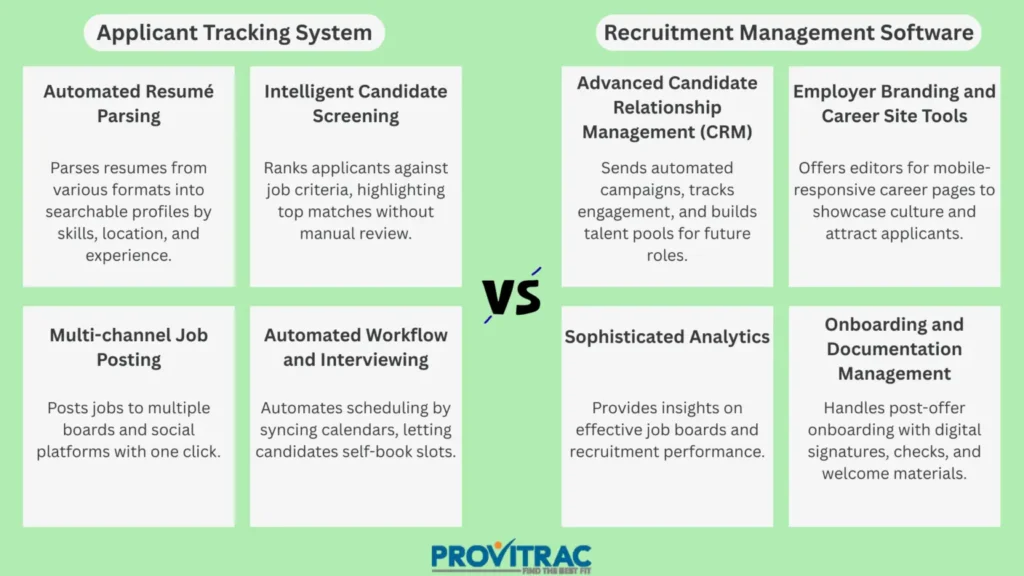
1. Automated Resumé Parsing
We can consider this feature as the “brain” of the best applicant tracking system since it’s mainly responsible for making sense of unstructured data. It takes various file formats (such as PDF and HTML) and converts them into a standardized digital profile that you can easily search by selecting categories like skills, location, and experience.
2. Intelligent Candidate Screening
Instead of reading every single cover letter, your recruiters can set specific criteria within their applicant tracking system. The system then ranks applicants based on how closely they match the job description and highlights the top talent immediately.
3. Multi-channel Job Posting
Another one of the essential features that make up the best applicant tracking system is the ability to broadcast job openings with just a single post. With a few clicks, you can push a listing to hundreds of job boards and social media platforms simultaneously.
4. Automated Workflow and Interviewing
The best applicant tracking system also has a feature that can handle the tedious “back and forth” of scheduling. It should be able to sync with your team’s calendars smoothly, allowing candidates to pick their own interview slots, which significantly reduces the time-to-hire.
The Rise of The Cloud-based Applicant Tracking System
While the internet gave us the connection, the cloud is the infrastructure that enabled the transformation of the hiring environment from office setups to digital spaces. Cloud based ATS is just one of the digital tools that support human activities, such as hiring, in our case. Owing to this shift, recruiters and hiring managers can collaborate seamlessly from any location around the globe, which is really a critical advantage for remote and hybrid workforces of the 21st century.
What is Recruitment Management Software?
While a standard applicant tracking system is great for filling a specific vacancy, a recruitment management suite is more like a long-term companion for your brand. It handles the entire hiring cycle, from the first time someone hears your company name to the moment they are sitting at their new desk. In the 2026 market, recruitment management is the leading tool for bridging the gap between marketing, sourcing, and HR operations.
Essential Features of Recruitment Management Software
Just like the applicant tracking software, the recruiting management software also comes with its own set of essential tools that drive productivity in its system. However, there is a fundamental shift in how these tools work. While the tools in the ATS solution are designed to handle the reactive approach of hiring (the application itself), the tools in the recruitment management software are designed for proactive hiring. Let’s talk about them in detail below.
1. Advanced Candidate Relationship Management (CRM)
The CRM is what we can consider the heart of recruiting management software. This feature allows you to send automated nurture campaigns, track candidate engagement, and build talent pools for future roles that haven’t even been posted yet.
2. Employer Branding and Career Site Tools
Most talent acquisition software includes built-in editors to create beautiful, mobile-responsive career pages. This helps you sell your company culture and convert passive browsers into active applicants.
3. Sophisticated Analytics
Good recruiting management software doesn’t just give you a bunch of numbers; it tells you what is working. You can see exactly which job boards are worth the money and which ones are just wasting your time.
4. Onboarding and Documentation Management
Once a candidate says “yes” to your offer, the recruiting management software transitions them into the onboarding phase. The transition feels professional for both you and the candidate because the system itself handles digital signatures, background check integrations, and welcome materials.
The bottom line is, unlike basic applicant tracking systems (ATS), recruitment management is not just a tracker but a relationship builder (more of the key difference later). With its heavy focus on the pre-application process, it uses tools to help you stay in touch with talented people who might not be ready to jump ship yet but would love to work for you down the road.
Key Differences Between Recruiting Management Software vs Application Tracking System
At first glance, it may look to you like these tools are doing the same job, but when you look closely, you’ll notice that their differences are significant, especially in their focus, functionality, and data handling. It would appear that while one is made for specific bursts of speed, the other is made for the long haul. Let’s dig more into the specific differences that set these two powerhouses apart.
1. Focus
The most immediate difference that you can spot between applicant tracking systems and recruitment management software is the “zoom level” they use to view your talent. An applicant tracking system is laser-focused on the narrow funnel that essentially acts as a project management tool for a single open role. Its primary job is to get a candidate from “Applied” to “Hired” as quickly as possible.
Recruiting management software, on the other hand, looks at the broad lifecycle. It treats every person in your recruitment software database as a long-term asset, managing the relationship from the first “hello” in the pre-application phase to their eventual onboarding and beyond.
2. Functionality
When you look at the day-to-day tools, the difference becomes even clearer. The best applicant tracking system is mainly built for administrative excellence. It means its core functionality revolves around compliance, legal tracking, and speed. Anything that makes sure that you and your team are following hiring laws and moving people through the pipeline without hitches.
On the flip side, you have a recruitment management software that is built for engagement and branding. It gives you the features that you need to run marketing campaigns, build beautiful career sites, and create a personalized experience that makes your company stand out in a crowded market. For online candidate research, an image reverse search can also help verify profile photos and identify reused images.

3. Data Handling
Finally, we have to look at how these systems handle sensitive information from candidates. A standard application tracking system is mostly transactional, meaning it only stores the data relevant to one specific application. However, recruiting management software offers incredible depth by creating a persistent, 360-degree view of a candidate. It tracks every email they have opened, every event they have attended, and every skill they have gained over the years.
To help you see how we move from a quick-fix tool to a big-picture strategy, we have put together a quick breakdown. This table shows exactly where an applicant tracking system ends, and a full recruitment management system begins.
Feature | Applicant Tracking System (ATS) | Recruitment Management Software (RMS) |
Primary Focus | The narrow funnel focuses on the “applied to hired” journey for a specific role. | The broad lifecycle focuses on the entire relationship from first contact to onboarding. |
Core Functionality | Administrative excellence: built for speed, compliance, and legal tracking. | Engagement & branding; built for marketing campaigns and candidate experience. |
Data Handling | Transactional: stores data specifically related to a single job application. | 360-Degree view: stores persistent, historical data on every interaction with a person. |
Conclusion: Recruiting Management Software vs Application Tracking System
Deciding between an applicant tracking system and recruiting management software really boils down to whether you need a high-speed engine to process current applications or a full-scale platform to grow your talent pool over time. While the best applicant tracking systems give you the speed and legal safety you need for active hiring, a recruitment management system turns your hiring into a smart, brand-driven strategy. Once you understand these differences, you can pick the tool that doesn’t just fill empty desks today but actually protects your growth for tomorrow.
When to Invest in an Applicant Tracking System or a Recruitment Management System?
If your main headache is sorting through a mountain of resumés and staying organized for active roles, an applicant tracking system is definitely your best starting point. However, if you are ready to stop reacting to vacancies and want to start building a pipeline of great people before you even need them, it is time to look at recruiting management software.
Try Provitrac Today! (It’s on Us)
Ready to see how the right software can take the stress out of your hiring? Sign up for a free demo of Provitrac to see what top-tier efficiency actually feels like. Our team is ready to help you start building your dream workforce today!